
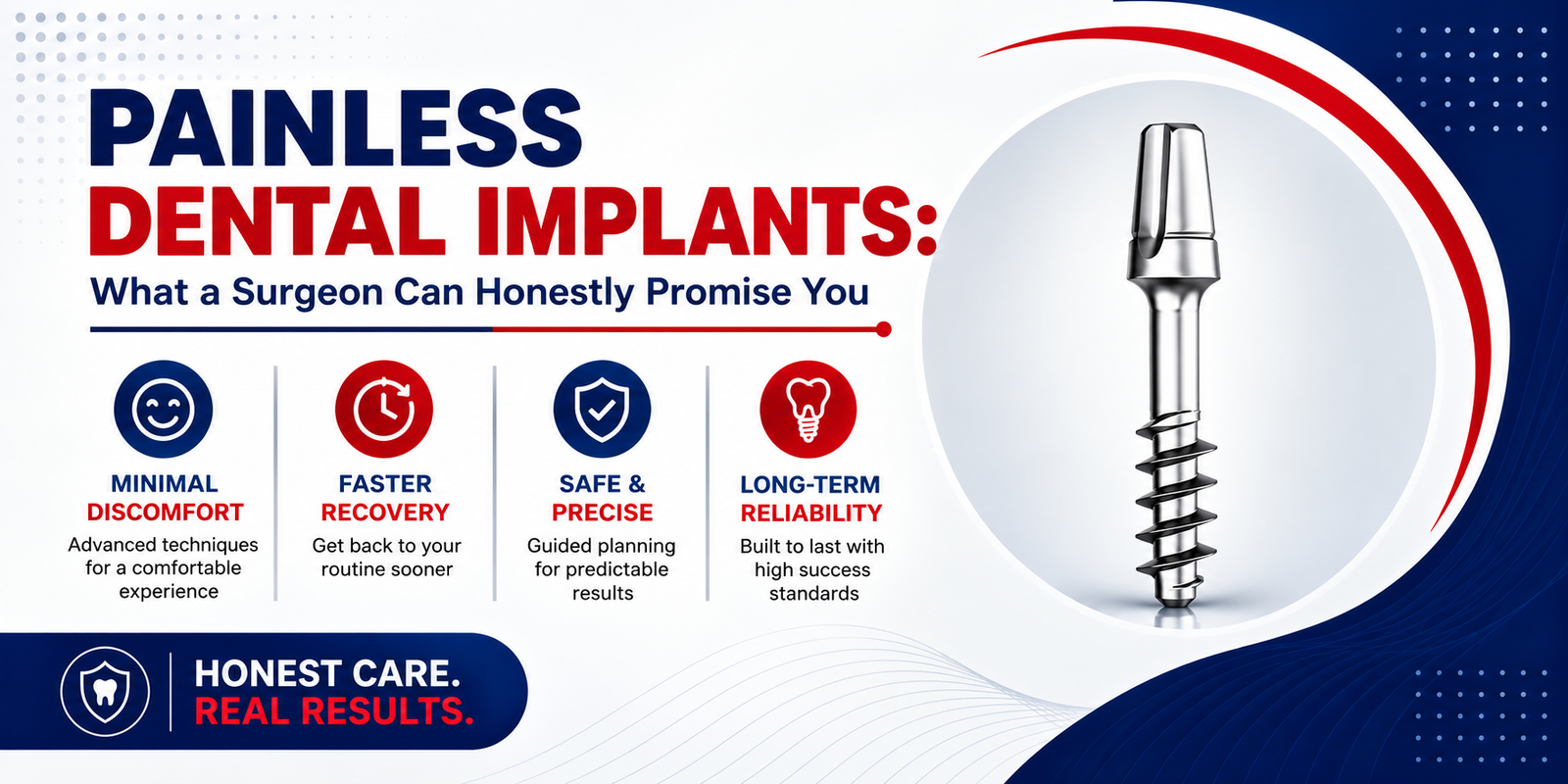
No surgery is literally painless — but implant placement is performed under local anaesthesia, so you should feel pressure and movement, not pain. When patients search for a Painless Dental Implants Surgeon, what they are really asking is whether the procedure will hurt, how bad the days afterwards will be, and whether anyone will tell them the truth. Here is that answer, without the marketing.
Why “Painless” is The Wrong Word — and What to Ask Instead
“Painless” gets used loosely in dental advertising. We avoid it, because it promises something no clinician can guarantee for every patient. A more useful question is: how is discomfort controlled, at which stage, and what should I realistically expect on day two?
At Simpladent Clinics, implant placement is carried out under local anaesthesia by a qualified dental surgeon. The area is numbed and tested before anything begins. Most patients describe the sensation during placement as pressure, tapping and vibration rather than sharp pain. If you feel anything sharp, you say so, and more anaesthetic is given. That is the standard, not a favour.
How the Corticobasal® Approach Changes the Comfort Picture
Simpladent works primarily with single-piece Corticobasal® implants placed using an immediate-loading protocol, under the method developed within the International Implant Foundation lineage. Two features of this approach affect comfort specifically:
Fewer surgical events. Conventional implant treatment in a resorbed jaw often requires bone grafting or a sinus lift first, healing time, then implant placement, then a second-stage exposure. That is multiple surgical episodes and multiple recovery periods. In suitable cases, the Corticobasal® protocol anchors implants in dense cortical bone and avoids the grafting stage — so there are fewer procedures to recover from overall.
Minimally invasive placement. Where the case allows, implants are placed through a small access rather than a wide raised flap. Less soft-tissue handling generally means less post-operative swelling. This is case-dependent; your surgeon will tell you before treatment which approach your anatomy requires.
Neither point means the surgery is sensation-free. It means the total burden of treatment is usually lower than a graft-and-stage pathway.
What the Days After Actually feel like
Expect some swelling and tenderness for roughly the first 48 to 72 hours, easing after that. Bruising is possible. You will be given prescribed pain relief and, where indicated, antibiotics — take them as directed rather than waiting for discomfort to build. A soft diet is advised in the early phase, and you will be asked not to smoke, because smoking impairs healing.
In suitable cases, fixed teeth are fitted within about 72 hours of placement. That matters for comfort in a practical way: you leave with a functioning fixed bridge rather than a removable temporary rubbing against healing tissue.
Contact the clinic promptly if you have pain that increases after day three, fever, or persistent bleeding. Those are not normal and should be assessed, not endured.
If y=You are Anxious about the Procedure
Dental anxiety is common and is not something to apologise for. Tell us at consultation. Options discussed may include anti-anxiety premedication or sedation alongside local anaesthesia, longer appointment pacing, and a full walk-through of the plan with your CBCT images before the day. Patients are consistently calmer when they have seen their own scan and understand what will happen.
Who This Suits — and Who it Doesn’t
Corticobasal® implants can suit patients with significant bone loss, long-term denture wearers, and those who want to avoid grafting. They are not automatically right for everyone. Suitability is determined by individual clinical assessment including imaging, medical history, gum condition and smoking status. Patients with diabetes or a smoking history may still be candidates after evaluation — but that is a finding, not a promise.
Conventional implants have a longer published evidence base, and outcome literature on basal/cortical implants remains limited in level. Where a conventional approach is the better answer for your case, you should be told so. We would rather lose a case than place the wrong implant.
FAQs
Will the implant surgery hurt?
You should not feel pain during placement under local anaesthesia — pressure and vibration are normal. Post-operative tenderness for two to three days is expected and managed with prescribed medication.
Is any dentist a “painless dental implants surgeon”?
No clinician can guarantee a painless experience. What you should look for is a qualified oral and maxillofacial surgeon or implantologist, proper imaging, clear anaesthesia and sedation options, and honest post-operative instructions.
How long until I can eat normally?
A soft diet is advised initially, with progression guided by your review appointments. Timelines depend on your case.
Do you guarantee the implants for life?
No. No responsible clinic does. What is offered is a defined follow-up and maintenance protocol, which is explained in writing before treatment.
What does it cost?
Cost depends on the number of implants, whether one or both arches are treated, prosthesis material, and imaging required. Figures are given after clinical assessment at consultation.
Talk to a dental surgeon before you decide. Simpladent Clinics is NABH-accredited and located at 4th Floor, KM Trade Tower, near Radisson Blu, Kaushambi, Ghaziabad. Toll-free: +91-844-844-77-63 · clinics@simpladent.in
Keep yourself updated by following our Social Page for the latest news and information.

 Facebook
 Youtube
 Twitter
 Instagram
 Linkedin

Leave A Comment