
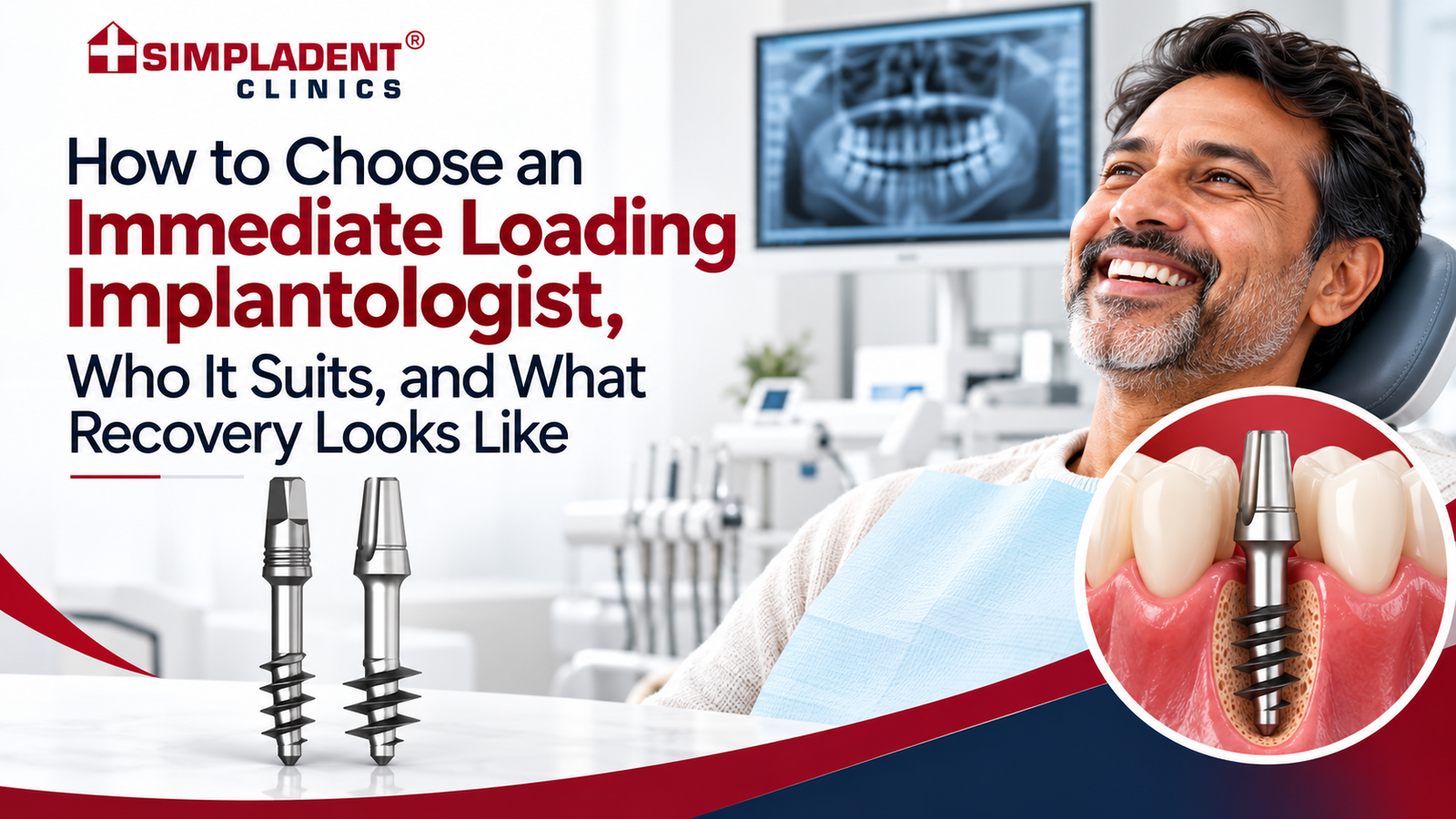
An immediate loading implantologist places dental implants and attaches working teeth to them within days, not months. To judge one, check three things: how they assess your bone and health before surgery, whether they measure implant stability on the day, and how openly they discuss risks and alternatives. Not everyone qualifies for fast loading, and a careful clinician will say so. This guide covers candidacy, questions to ask, warning signs and recovery.
Immediate Loading vs Immediate Implants: Two Different Clocks
These terms are often mixed up.
- Immediate implants: the implant goes into the socket in the same visit the tooth is removed. This is about placement timing.
- Immediate loading implants: a crown or bridge is fixed on the implant soon after surgery, usually within one week by common clinical definitions. This is about tooth timing.
You can have either one alone, or both together. At Simpladent, the usual gap from surgery to fixed teeth is.
Who Is and Is Not a Candidate
Suitability depends on your mouth and your general health. An implantologist looks at:
- Bone quality and volume. Dense bone holds an implant firmly from day one. Soft or thin bone may not.
- Gum health. Active gum disease must be treated first.
- Smoking. Nicotine narrows blood vessels, so less blood reaches the healing bone. Published studies link smoking to higher implant failure and peri-implantitis rates.
- Diabetes. Well-controlled diabetes may be acceptable after assessment. Poor sugar control slows healing.
- Bite forces. Clenching or grinding (bruxism) can overload a new implant.
- Medicines and history. Bone-strengthening drugs or past radiation to the jaw need careful review.
What an Immediate Loading Implantologist Should Check Before Loading
Good planning starts before surgery:
- A CBCT scan to measure bone height, width, and the position of nerves and sinuses.
- Your medical history and current medicines.
- Your bite, to spot heavy contact points.
- Primary stability, measured during surgery.
That last point is the one patients rarely hear about. Many immediate-loading protocols look for an insertion torque of roughly 30–35 Ncm or higher before fitting teeth. Below that, chewing can move the implant. Movement beyond a small threshold (often quoted as 50–150 microns) can lead to soft scar tissue forming instead of bone, and osseointegration fails.
In full-arch cases, the implants are joined by a rigid provisional bridge. This spreads chewing forces across all implants and limits that movement.
7 Questions to Ask Before Booking
- Who places the implant, and what implant-specific training do they have?
- Which implant system do you use, and is it licensed for sale in India?
- Will I get a CBCT scan, and will you walk me through the plan?
- What happens if the implant isn’t stable enough on surgery day?
- Are the first teeth provisional or final? When are they replaced?
- Which follow-up visits are included, and who do I call if there’s a problem?
- What are the risks in my case, and what are my alternatives, such as delayed loading or a bone graft?
Recovery and Aftercare
Most swelling settles within a few days. Expect a soft diet during the healing period; your clinician sets the exact timeline. Brush gently around the implants, use interdental brushes or a water flosser, and avoid smoking. Keep every review visit. Over the long term, regular hygiene checks do more than anything else to keep implants healthy.
Cost Factors
Fees vary by case. The main drivers are:
- Number of implants, and single tooth vs full arch.
- Need for a bone graft or other extra procedures.
- Imaging and planning.
- Provisional and final prosthesis material.
- Case complexity and number of visits.
When Delayed Loading Is the Safer Choice
Fast loading isn’t always the right call. Waiting usually makes more sense when:
- Insertion torque is low or the bone is soft.
- There is active infection at the extraction site.
- Heavy grinding can’t be controlled.
- Diabetes is poorly managed.
- A major bone graft was placed.
Conventional delayed loading also has a longer evidence base. A skilled implantologist will change the plan during surgery if stability isn’t good enough, rather than force teeth onto an implant that isn’t ready.
Making Your Choice
The right Immediate Loading Implantologist explains your options, measures before loading, and tells you plainly when waiting is better. See how our team approaches the procedure on our immediate loading treatment page, or visit our implant clinic in Kaushambi or Ghaziabad clinic.
Frequently Asked Questions
Can I get fixed teeth the same day as my implant surgery?
Sometimes, but it depends on your bone and the stability measured during surgery. Many clinics fit teeth within a few days rather than the same day, to allow time to make the provisional bridge. Your implantologist confirms the timeline after a CBCT scan and examination.
I have diabetes. Can I still get immediate loading implants?
Possibly. Patients with well-controlled diabetes may be suitable after individual assessment. Poorly controlled blood sugar slows healing and raises infection risk, so your implantologist may ask for recent blood test results and coordinate with your physician. If control is poor, delayed loading is often the safer option.
What happens if my implant doesn’t fuse with the bone?
If an implant fails to integrate, it is usually removed, the area is allowed to heal, and a new implant is placed later, sometimes with a bone graft. Ask before treatment how the clinic handles failures, what costs apply, and who manages your follow-up care.
Are the teeth I get first my final teeth?
Often not. Many immediate-loading cases start with a provisional crown or bridge, made to be light and easy to adjust while the bone heals. The final teeth are fitted after the healing period. Ask your clinic which type you will receive and when it will be replaced.
How do I know if my jawbone is strong enough?
You can’t tell from symptoms alone. A CBCT scan shows bone height, width and density, along with nearby nerves and sinuses. Your implantologist combines this with a clinical exam to decide whether immediate loading, delayed loading or a bone graft is the right route for you.
Want to know if fast loading suits your case? Book a free consultation with our team.

 Facebook
 Youtube
 Twitter
 Instagram
 Linkedin


Leave A Comment