
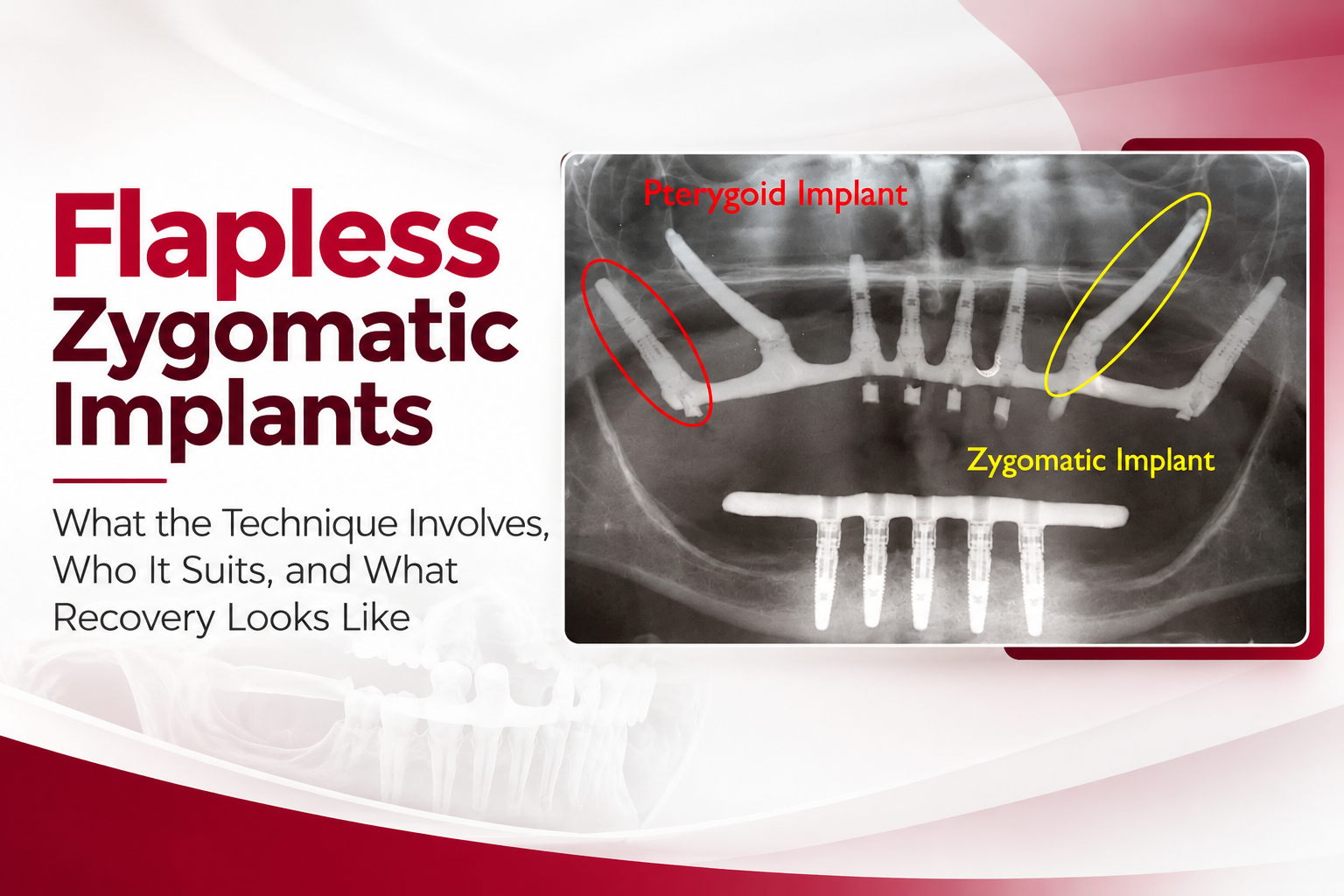
Flapless zygomatic implants are long implants anchored in the cheekbone (zygoma) and placed through small openings in the gum instead of a large surgical flap. The aim is less swelling and a gentler first week. The technique depends on detailed CBCT planning and specialist skill, and not every resorbed upper jaw is suitable.
If a dentist has told you there is “no bone” in your upper jaw, you have probably already read the basics of zygomatic implants on our zygomatic implant treatment page. This article covers what comes next: how the flapless approach works, where it carries extra difficulty, and what you should ask before agreeing to it.
What “Flapless” Actually Means in Zygomatic Surgery
Every zygomatic implant follows a long, angled path. It starts near the gum line in the upper jaw, travels along or through the wall of the maxillary sinus, and ends in the dense bone of the cheek. The question is how the surgeon reaches that path.
The conventional flap approach
The traditional method opens the gum along the ridge and lifts it back, exposing the bone and the side wall of the sinus. The surgeon can see the bone directly while drilling. That visibility is the main advantage. The cost is a bigger wound, more stitches, and usually more swelling and bruising afterwards.
The flapless approach
In flapless placement, the gum is not peeled back. The implant enters through a small access point, and the surgeon relies on the pre-surgical plan, a guide, or real-time navigation to stay on the planned path. Less tissue is disturbed, so the body has less to repair.
[Clinic-specific protocol: does Simpladent use a static guide, dynamic navigation, or a planned freehand flapless technique? UNVERIFIED — surgeon to confirm]
Flapless vs Conventional Flap Zygomatic Implants
Factor Flapless zygomatic Conventional flap zygomatic
Gum incision Small access points Long incision along the ridge
Direct view of bone Limited Full
Reliance on planning tech High (CBCT, guide or navigation) Moderate
Early swelling and pain Lower in available trial data Higher in available trial data
Stitches Fewer or none [UNVERIFIED] More
Anaesthesia Local reported in trials; sedation or GA may
be used [confirm clinic protocol] Often general anaesthesia
Can switch approach mid-surgery Yes, to flap if needed Not applicable
Suitable anatomy Selected cases only Wider range
Why Flapless Zygomatic Implants Are Technically Demanding
Removing the flap removes the surgeon’s direct view. The implant is long, steeply angled, and passes close to the sinus, the eye socket floor and nerves in the cheek. Small errors at the entry point grow larger by the time the tip reaches the zygoma.
CBCT planning comes first
A CBCT scan gives a 3D picture of the jaw, sinus and cheekbone. The surgeon uses it to measure bone, map the sinus, and plan each implant’s entry point, angle and length before the day of surgery. Without a careful CBCT plan, Flapless Zygomatic Implants should not be attempted.
Guided and navigated placement
Some surgeons transfer the plan using a printed surgical guide. Others use dynamic navigation, where a camera tracks the drill against the CBCT plan in real time. One randomised trial of 20 patients compared flapless and conventional placement, with both groups guided by dynamic navigation under local anaesthesia. The researchers stressed that proper training in navigation is essential before using it on patients.
The Sinus Question: What Happens to the Maxillary Sinus?
Severe maxillary atrophy often happens alongside an enlarged sinus. A zygomatic implant must pass near or through that sinus, so the sinus lining (Schneiderian membrane) is a key structure in the plan.
Possible problems include a tear in the sinus lining, sinus infection, and long-term sinusitis. In the trial above, three patients developed chronic sinusitis — one in the flapless group and two in the flap group. Flapless placement does not remove sinus risk.
Before surgery, your CBCT should be checked for existing sinus disease. Active sinusitis may need treatment, sometimes with an ENT specialist, before implants are placed. After surgery, report blocked nose, facial pressure, or discharge on one side promptly.
Who Is Not a Candidate for Zygomatic Implants?
Zygomatic implants are a specialist option, not a default. Treatment may need to be delayed, changed or ruled out in these situations:
- Untreated sinus infection or sinus disease seen on CBCT
- Poorly controlled diabetes or other uncontrolled medical conditions
- Recent or ongoing radiation therapy to the head and neck
- Certain bone medications, such as some antiresorptive drugs, depending on dose and route
- Heavy smoking, which raises the risk of infection and implant failure
- Cheekbone anatomy that cannot hold the implant securely
- Inability to attend follow-up visits or keep up cleaning at home
Patients with diabetes or a smoking history may still be considered after individual assessment. Flapless placement in particular needs favourable anatomy. If the CBCT shows unclear landmarks, a flap approach may be safer.
How Zygomatic Implants Compare With Other Options
Each option suits a different pattern of bone loss. Your CBCT decides which is realistic.
- Flapless zygomatic: small access, gentler early recovery, depends heavily on planning and skill.
- Flap zygomatic: full view of the bone, more swelling, suits a wider range of anatomy.
- Quad zygoma: four zygomatic implants, two per side, used when the front of the upper jaw also lacks bone. See our zygomatic implant treatment page.
- Pterygoid implants: angled into the bone behind the upper jaw, often used to support the back teeth without a sinus lift.
- All-on-4 with tilted implants: conventional implants angled to avoid the sinus, needing some bone at the front.
- Basal / cortical implants: Simpladent’s core method, anchoring in dense cortical bone; read how immediate loading works.
- Sinus lift with conventional implants: rebuilds bone first, with a longer overall timeline.
Recovery Timeline and Soreness:What to Expect
In the randomised trial, early pain and swelling were significantly higher in the flap group than in the flapless group. That is one small study from one team, so your own experience may differ.
A typical recovery outline:
- Days 1–3: Swelling and soreness peak. Cold packs, prescribed pain relief and antibiotics as directed.
- Week 1: Soft food only. Avoid blowing your nose hard. Some cheek bruising is possible.
- Weeks 2–4: Swelling settles. Stitches, if any, are removed or dissolve.
- Months 3–6: The implants bond with bone (osseointegration). The final prosthesis is usually fitted after this period.
If implant stability allows, a fixed provisional prosthesis may be fitted soon after surgery with immediate loading. This depends on your case and is decided on the day.
Long-term maintenance
Zygomatic implants need the same care as any fixed bridge, plus extra attention to the gum around the implant heads. Expect:
- Daily cleaning under the bridge with a water flosser or interdental brushes
- Professional reviews and hygiene visits
- Periodic X-rays or CBCT to check bone and the sinus
- Repair or replacement of the prosthesis over time
Questions to Ask a Surgeon Before Agreeing to Flapless Zygomatic Implants
- How many zygomatic cases have you done, and how many were flapless?
- Will you use navigation, a printed guide, or freehand placement — and why for my case?
- What does my CBCT show about my sinus and cheekbone?
- If flapless isn’t safe on the day, will you switch to a flap?
- Will I have local anaesthesia, sedation or general anaesthesia?
- What happens if an implant fails or the sinus becomes infected?
- When will I get provisional teeth, and when the final ones?
- What follow-up and maintenance is included?
You can also browse our general implant FAQs or visit our implant clinic in Kaushambi, Ghaziabad.
Book a CBCT-based consultation to find out whether zygomatic implants — flapless or otherwise — suit your jaw. Call +9192896 78860 or email clinics@simpladent.in.
FAQ
Is flapless zygomatic surgery less painful than the flap method?
Early trial data suggests less pain and swelling with flapless placement, because the gum is not opened widely. However, the evidence comes from small studies, and discomfort varies by person. Local anaesthesia and prescribed pain relief are used, and your surgeon will explain what to expect for your case.
Can everyone with severe upper jaw bone loss have flapless zygomatic implants?
No. Flapless placement needs clear anatomy on the CBCT scan and a surgeon trained in guided or navigated techniques. Sinus disease, unclear landmarks, or certain medical conditions may make a flap approach, a different implant type, or a delay safer. Suitability is decided after individual assessment.
Do zygomatic implants affect the sinus?
They can. The implant passes near or through the maxillary sinus, so tears in the sinus lining, infection and chronic sinusitis are recognised risks with both flapless and flap methods. Existing sinus problems are usually treated first. Report one-sided blockage, pressure or discharge after surgery.
How long does recovery take after flapless zygomatic implants?
Swelling usually peaks in the first few days and settles over two to four weeks. Bone integration takes several months before the final teeth are fitted. Exact timelines depend on your health, healing and the clinic’s protocol, which your surgeon will explain at consultation.
Can I get fixed teeth soon after zygomatic implant surgery?
In suitable cases, a fixed provisional bridge may be attached shortly after surgery through immediate loading. This depends on how stable the implants are when placed. If stability is not enough, the surgeon may wait. The final bridge usually follows once healing is complete.

 Facebook
 Youtube
 Twitter
 Instagram
 Linkedin


Leave A Comment