
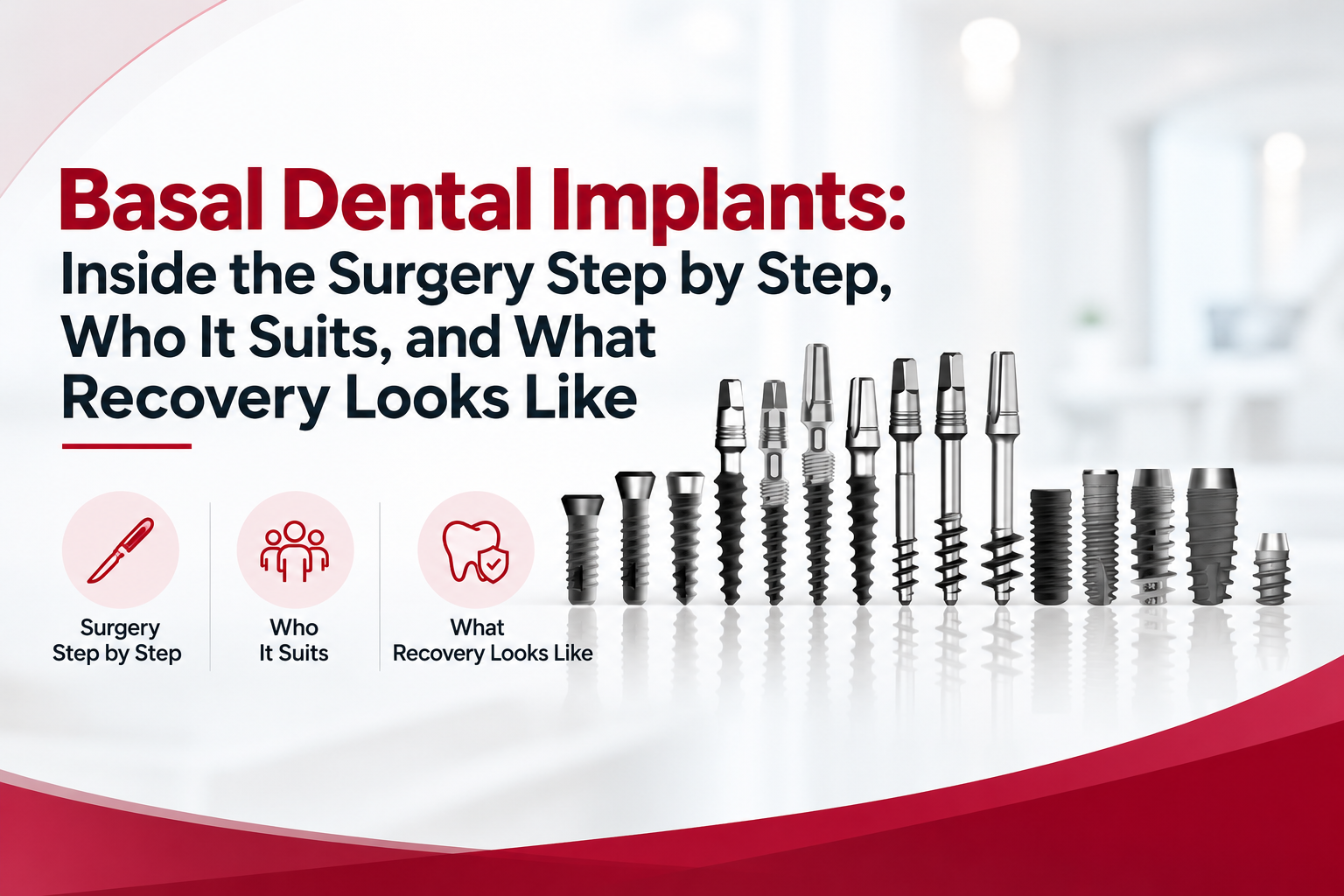
Basal dental implant surgery is usually one planned session. The surgeon removes failing teeth, prepares narrow channels toward dense cortical bone, places single-piece implants, and anchors them so a fixed bridge can be attached soon after. The implant matters, but outcomes depend more on planning, angulation and bite design, which only the surgeon controls. Here is what happens at each stage, and what to ask before choosing who does it.
Pre-surgical Planning: Reading the Bone First
Every case starts with imaging. An OPG gives the overview. A CBCT scan shows the jaw in three dimensions, so we can map where cortical bone is thick enough to hold an implant and where the nerve canal and sinus floor sit. Because these implants rely on the dense outer layers of the jaw rather than the softer bone around tooth roots, the plan is essentially a map of cortical plates and safe routes to reach them.
Case selection happens here too. Uncontrolled diabetes, past radiation to the jaw, certain bone-related medications, heavy smoking and severe grinding are discussed openly. Some patients are better served by conventional implants, and we say so. Treatment suitability is decided after clinical examination and imaging.
The Basal Implant Kit: What Each Instrument is for
In general terms, a basal implant kit is organised around a few jobs: preparing a narrow channel toward cortical bone, seating the implant, confirming engagement, and adjusting the head of each single-piece implant so several implants line up to carry one bridge.
For dentists assessing a Basal Implant Kit: check that every component is traceable to a registered importer, and that the drill sequence matches the specific implant design you are placing. Mixing instruments across systems is a common source of avoidable problems.
Disclosure: Simpladent Implant Solutions is the CDSCO-registered importer/distributor of the implant system used.
The Basal Dental Implant Surgical Protocol, Step by Step
- Anaesthesia and extraction. Under local anaesthesia, teeth that cannot be saved are removed and the sockets cleaned. Implants can often be placed in the same sitting.
- Osteotomy. A narrow channel is prepared along the planned angle, often through the gum with little or no flap.
- Placement. The implant is inserted until its thread engages cortical bone.
- Bicortical anchorage. Where anatomy allows, the tip engages a second cortical plate on the far side of the jaw. This two-point grip is what makes immediate functional loading possible.
- Alignment and records. Implant heads are adjusted to a common path, and impressions or scans are taken.
- Immediate loading. A rigid bridge splints the implants together so they share chewing forces. Timing is explained on our immediate-loading page.
Why the surgeon matters more than the implant
Two surgeons can use the same strategic implant system and get different results. A few degrees of wrong angulation can miss the cortical plate or bring the implant closer to a nerve. Primary stability has to be judged at the moment of placement, because there is no healing period to fall back on. And the bridge must be designed for even, balanced contacts on both sides; an uneven bite overloads individual implants.
What to look for in a strategic implants surgeon in India
Training standards vary widely across basal implants India, so ask direct questions:
- Training: where and how the surgeon trained in the strategic implant method.
- Case volume: experience with cases like yours (full arch, upper jaw near the sinus, severe bone loss).
- Follow-up: who does bite adjustments and reviews after the bridge is fitted.
- Retrieval plan: if an implant loosens, how it is removed and replaced, and what that costs.
- Imaging before a quote: a reliable plan cannot be priced without a scan.
Want your scan reviewed before deciding anything? Call +91 92896 78860 to book an assessment.
Realistic recovery and follow-up
Most patients have swelling and soreness for the first few days, managed with prescribed medication. A soft diet is advised in the early weeks. Expect a review within the first week, then bite checks over the following months as the bridge settles, and periodic long-term reviews. [VERIFY: clinic’s exact review schedule]
Limitations and risks, stated plainly
- An implant can lose stability and need removal and replacement.
- Infection, swelling, or inflammation of the gum around the implant can occur.
- Poor angulation risks nerve or sinus injury, which is why planning matters.
- Bridges can fracture or need adjustment.
- Long-term evidence is limited.
Our clinical rationale follows from this. We consider basal implants mainly for patients with significant bone loss who want to avoid grafting or long healing periods. Patients with good bone volume and no time pressure may be better suited to conventional implants, which have a longer track record.
Basal vs conventional implants at a glance
| Factor | Basal (cortical) implants | Conventional implants |
| Anchorage | Dense cortical bone, often bicortical | Alveolar (tooth-bearing) bone |
| Bone grafting | Often avoided in suitable cases | Often needed when bone is thin |
| Loading | Usually immediate | Often delayed for healing |
| Design | Single-piece | Usually two-piece (implant + abutment) |
| Long-term evidence | Limited, mostly low-level | Extensive, long-term data |
Basal implants India: what affects the cost
We do not quote fixed prices online, because cost depends on the case:
- Number of implants and whether one or both jaws are treated
- Bridge material
- Imaging (OPG, CBCT)
- Extractions and case complexity
- Travel and stay for international patients (see dental tourism)
Full-arch planning is covered on our full mouth implant page, and general treatment details on dental implants.
Frequently asked questions
How long does basal implant surgery take?
Most single-arch cases are completed in one session lasting a few hours, though timing depends on the number of extractions and implants. The surgeon confirms an estimate after reviewing your CBCT scan. Fitting the fixed bridge is a separate step that follows within days.
Is basal implant surgery done under general anaesthesia?
Usually not. Most procedures are done under local anaesthesia, with sedation discussed for anxious patients or longer cases. Your medical history, the extent of surgery and your comfort level guide this decision, which is made with you during the consultation.
What happens if a basal implant fails?
A single-piece implant that loses stability can usually be removed and a new one placed, often in a different position. This is why you should ask any surgeon about their retrieval plan and costs before treatment. Regular follow-ups help catch problems early.
How do I check a strategic implants surgeon in India?
Ask about their specific training in the strategic implant method, how many similar cases they treat, and who handles follow-up. Ask to see your own scan explained. A surgeon who discusses risks and alternatives openly is a better sign than one promising guaranteed results.
Can dentists learn the basal implant protocol?
Yes, through structured training that covers imaging, case selection, surgical technique and bite design. Hands-on supervised cases matter more than theory alone. Dentists should also confirm that the implant system they use is supplied through a registered importer with traceable components.

 Facebook
 Youtube
 Twitter
 Instagram
 Linkedin


Leave A Comment