
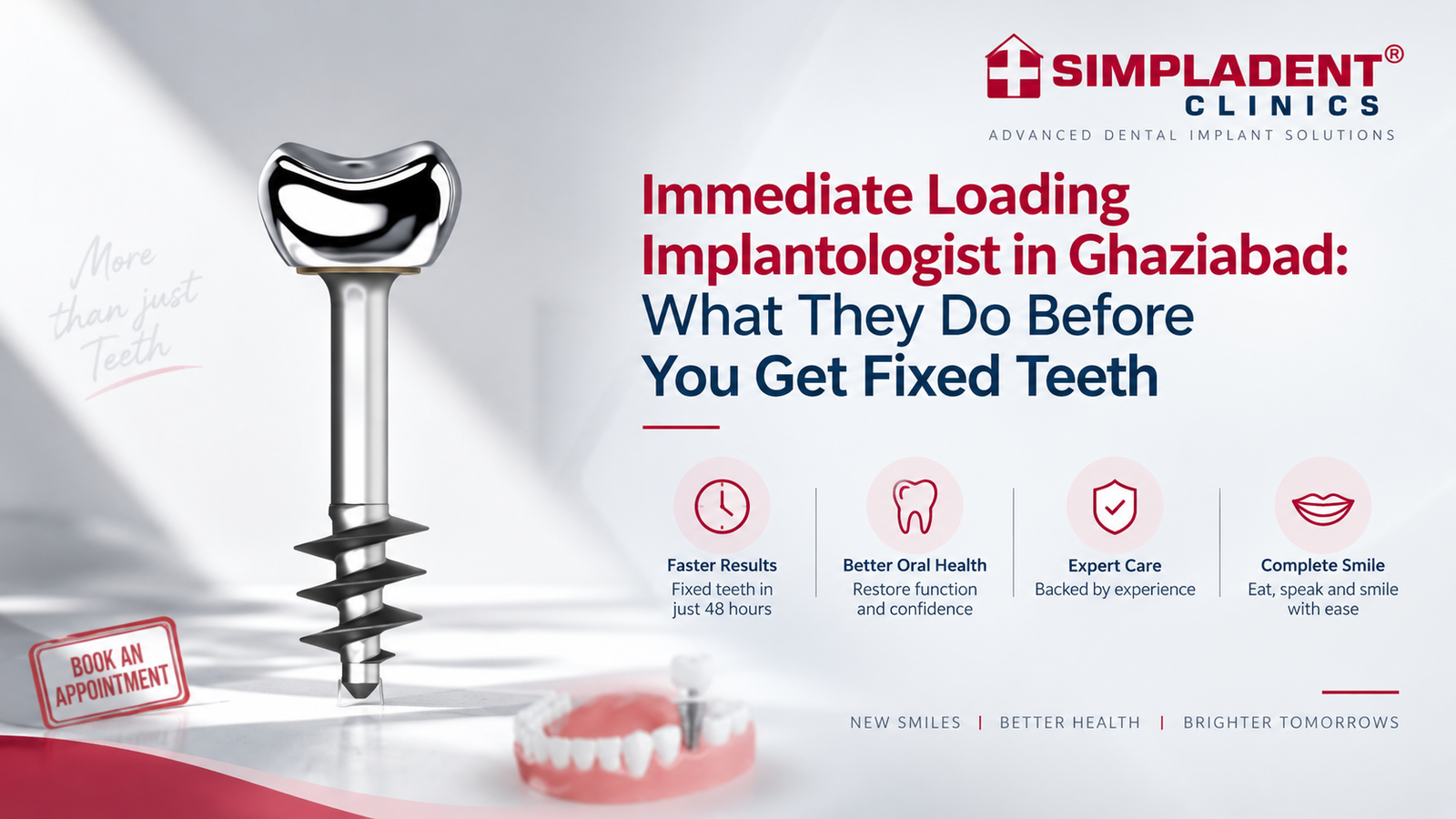
If you’re researching immediate loading implants, the most important decision isn’t the implant brand — it’s the Immediate Loading Implantologist planning your case. Immediate loading means a fixed provisional tooth or bridge can be attached to the implant soon after placement, instead of the traditional multi-month waiting period. Whether that’s right for you depends on bone quality, bite force, and a surgeon experienced specifically in this protocol.
At Simpladent Clinics in Ghaziabad (Kaushambi), Dr. Vivek Gaur, Oral & Maxillofacial Surgeon (M.D.S.), evaluates candidacy for immediate implants case by case — because not every patient is suited to same-visit loading, and an honest implantologist will tell you that upfront.
What “Immediate Loading” Actually Means
Conventional implants are left to heal, unloaded, for several months before a crown is attached. Immediate loading implants are designed and placed so a temporary fixed tooth can go on much sooner — often the same day or within days — provided the implant achieves enough initial stability in the jawbone. This isn’t a shortcut; it’s a specific surgical and prosthetic protocol that requires accurate imaging, careful implant selection, and a surgeon trained in immediate-loading case planning.
How an Immediate Loading Implantologist Plans Your Case
Clinical and radiographic assessment — a CBCT/OPG scan maps bone density, nerve position, and sinus anatomy.
Candidacy evaluation — the implantologist checks whether your bone can support immediate stability, and reviews any diabetes, smoking, or bruxism history that could affect healing.
Implant selection and placement — implants are positioned to distribute bite forces evenly, which is central to immediate loading success.
Provisional fixed teeth — a temporary fixed prosthesis is attached, typically within about 72 hours, though the exact timeline depends on your individual case and is confirmed at consultation.
Follow-up and final prosthesis — healing is monitored before the permanent restoration is placed.
Who Is (and Isn’t) a Good Candidate
Immediate implants can suit patients with sufficient bone density who want to avoid a long edentulous period. They may be considered for patients with diabetes or a smoking history after individual assessment, but candidacy isn’t automatic — uncontrolled conditions, very low bone volume, or active infection can rule it out. A candid implantologist will walk you through where you personally stand, not just what’s technically possible.
What to Expect at Your First Visit in Ghaziabad
Your first visit at Simpladent Clinics typically includes a clinical exam, imaging, and a direct conversation about whether immediate loading fits your case — or whether a staged approach is more appropriate. Cost depends on the number of implants, arch involved, prosthesis material, and imaging required; your implantologist will walk through these factors and confirm details at consultation rather than quoting a number sight unseen.
Immediate Loading vs. Conventional Implants: An Honest Comparison
Immediate loading can reduce the time you spend without fixed teeth, which matters for many patients. Conventional implants have a longer-established evidence base and remain the standard recommendation in certain bone conditions. Neither approach is universally superior — an experienced implantologist recommends based on your bone quality, bite, and health history, not on which method sounds more advanced.
FAQ
Is immediate loading right for everyone?
No. It depends on bone density, bite force, and general health. Some patients are better suited to a staged (conventional) approach after assessment.
How soon will I have fixed teeth?
In suitable cases, a temporary fixed prosthesis is typically attached within about 72 hours of implant placement, but this varies by case and is confirmed during your consultation.
Does immediate loading implant success depend on the implantologist?
Yes — case selection, imaging accuracy, and precise implant placement are what determine whether immediate loading is appropriate and successful, more than the implant hardware itself.
Can smokers or diabetics get immediate implants?
Possibly, after individual evaluation. These factors affect healing and are assessed before any treatment plan is finalized.
Is there a guarantee the implants will last a lifetime?
No responsible implantologist guarantees implant outcomes. Longevity depends on oral hygiene, follow-up care, and individual healing.
Keep yourself updated by following our Social Page for the latest news and information.

 Facebook
 Youtube
 Twitter
 Instagram
 Linkedin

Leave A Comment