
Losing a tooth is not only a cosmetic problem. The jawbone that once supported that tooth begins to lose volume, neighbouring teeth drift, and chewing shifts to one side. Dental implants are the treatment designed to address the root of that problem — they replace the missing root itself, not just the visible crown.
But “dental implants” is not one procedure. It is a family of them, and the version that suits a patient with a single missing molar is not the version that suits someone who has worn a loose denture for a decade. Understanding the difference is the most useful thing you can do before your first consultation.
What a Dental Implant Actually is
An implant is a biocompatible titanium post placed into the jawbone to act as an artificial tooth root. Bone cells grow against and around it — a process called osseointegration — and once that connection is stable, a crown, bridge or full arch of teeth can be supported on it.
Two design philosophies dominate implant dentistry.
Conventional implants anchor into the softer alveolar bone at the top of the jaw ridge. This is the most widely practised approach worldwide and has the longest published follow-up data behind it. Where bone volume is insufficient, it often requires grafting or a sinus lift first, followed by a healing period of several months before teeth are fitted.
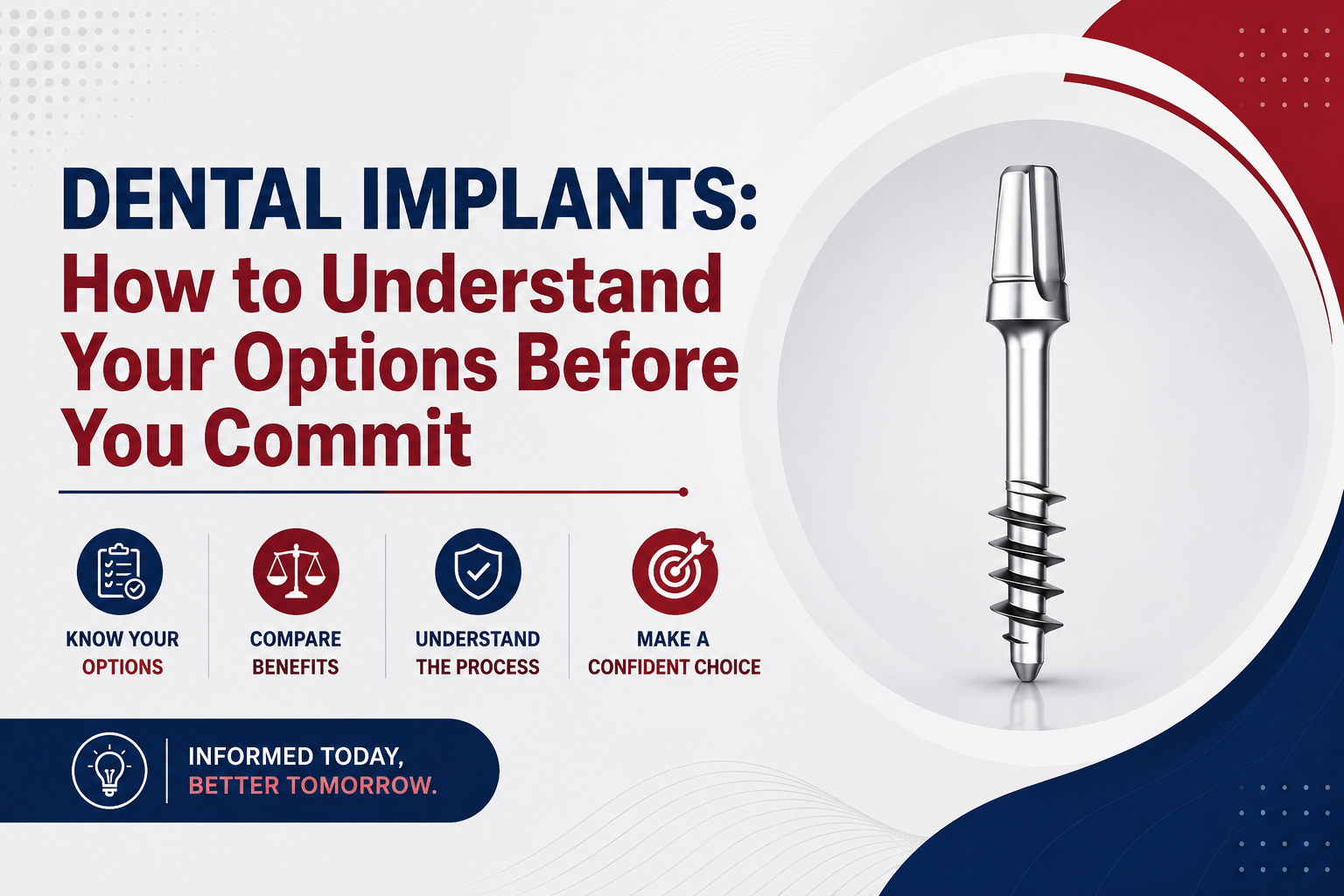
Basal or cortical implants — the approach Simpladent Clinics specialises in — anchor into the dense cortical bone deeper in the jaw. Cortical bone resorbs far less than alveolar bone and is usually still available even where the ridge has thinned considerably. These are typically single-piece implants, and in suitable cases they allow fixed teeth to be fitted within about 72 hours rather than after months of healing.
Why Implant Type is Decided By Your Bone, Not Your Preference
Patients often arrive having already chosen a method from something they read online. In practice the decision is made by imaging.
A CBCT scan or OPG shows where usable bone still exists, its density, and where the sinus floor and nerve canals sit. Those findings determine which implant designs are viable. Someone with generous ridge height has more options open to them. Someone who lost their molars fifteen years ago may find the ridge too thin for conventional placement without grafting — which is precisely the situation cortical anchorage was developed for.
This is also why remote quotes should be treated cautiously. Any plan issued before imaging is an estimate, not a treatment plan.
The Implant Systems Used at Simpladent Clinics
Simpladent Clinics works with implants manufactured by Simpladent GmbH in Gommiswald, Switzerland, distributed in India under CDSCO licensing. The range includes several designs intended for different clinical situations — among them the BECES® bicortical screw, BECES EX for placement into a fresh extraction socket, KOC compression designs, Hexacone, and ZDI zygomatic implants for severely resorbed upper jaws where conventional anchorage is no longer available.
The system matters less than the assessment that selects it. As with any surgical discipline, outcomes rest heavily on diagnosis, placement technique and the prosthetic work that follows.
Who Dental Implants May Not Suit
Honest candidacy limits matter more than a list of benefits, so it is worth stating them plainly.
Uncontrolled diabetes, active gum infection, heavy smoking, certain bone-affecting medications such as bisphosphonates, recent head and neck radiotherapy, and some autoimmune conditions all affect healing and implant stability. None of these is automatically disqualifying — many patients with diabetes or a smoking history are treated successfully after individual assessment and medical stabilisation — but they change the risk profile, and any dental surgeon who tells you otherwise without examining you is overselling.
Growing adolescents are generally not candidates until jaw growth is complete.
It is also worth knowing that peri-implantitis — inflammation of the tissue around an implant — remains a genuine long-term risk with all implant systems. Polished single-piece designs are intended to reduce plaque retention at the tissue interface, but no implant is immune, and long-term maintenance appointments are part of the treatment, not an optional extra.
What to Ask at Your Consultation
Which implant system is being proposed for my case, and why that one?
What does my scan actually show about my bone?
How many appointments, and over what timeline?
What is included in the quoted figure — imaging, surgery, prosthesis, review visits?
What happens if something fails, and what is the maintenance schedule?
A clinic that answers these directly is giving you the information you need to decide. One that answers with guarantees is not.
Discussing Your Case With Simpladent Clinics
Simpladent Clinics is NABH-accredited and led by Dr. Vivek Gaur, Oral and Maxillofacial Surgeon. Cost depends on the number of implants, whether one or both arches are treated, prosthesis material, imaging required and overall case complexity — which is why figures are discussed after assessment rather than quoted upfront.
To arrange a consultation, call the toll-free line on +91-844-844-77-63 or email clinics@simpladent.in. The clinic is at 4th Floor, KM Trade Tower, near Radisson Blu, Kaushambi, Ghaziabad.
Keep yourself updated by following our Social Page for the latest news and information.

 Facebook
 Youtube
 Twitter
 Instagram
 Linkedin

Leave A Comment