
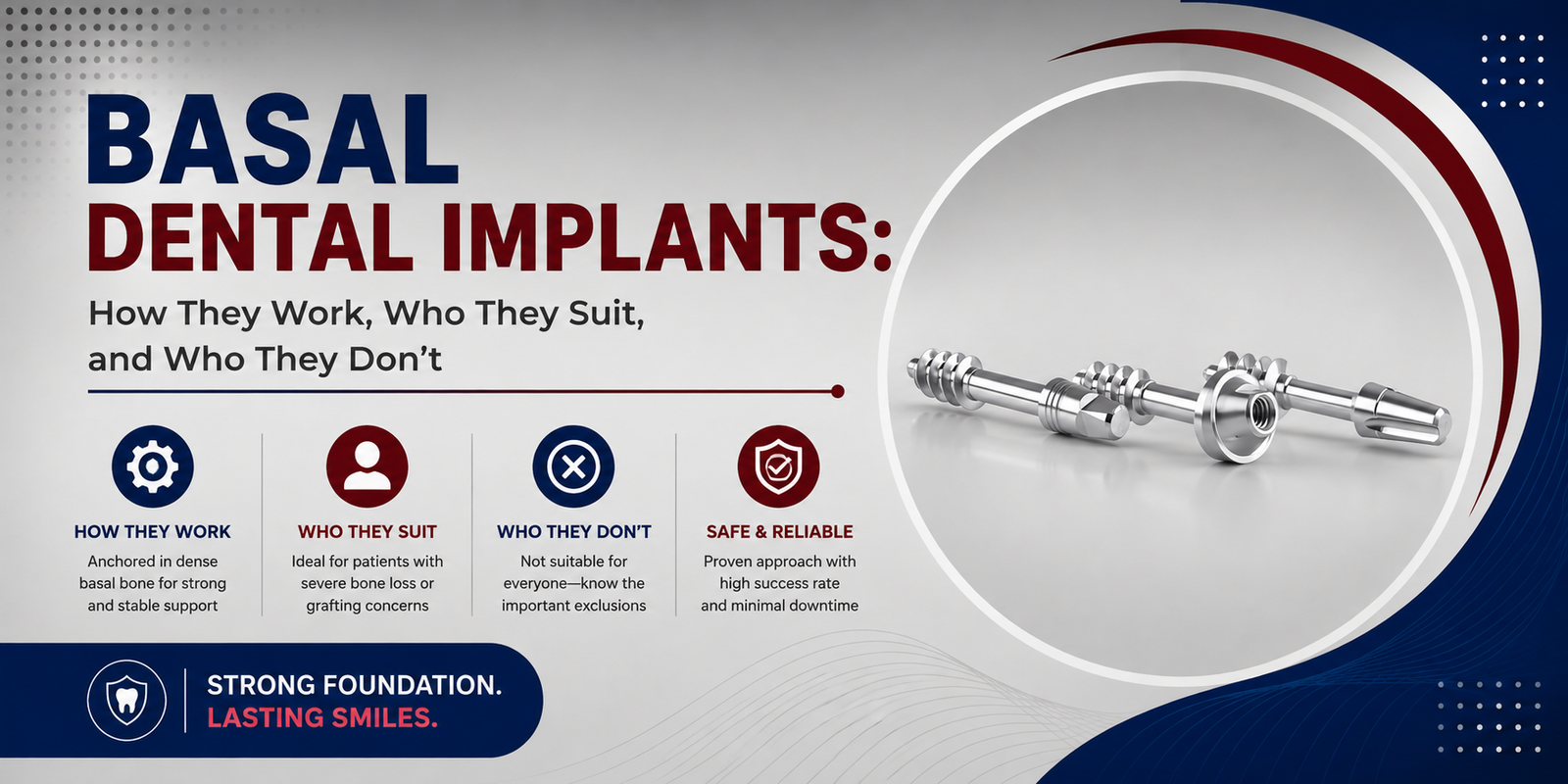
Basal dental implants are single-piece implants anchored in the cortical bone of the jaw rather than the softer cancellous bone that conventional implants rely on. Because cortical bone is dense and resorption-stable, these implants can often be loaded with a fixed bridge within about 72 hours, and in suitable cases they avoid bone grafting, sinus lift, and nerve repositioning altogether. They are not a better implant than conventional ones in every situation — they are a different solution to a specific problem: not enough bone, or not enough time.
That distinction matters, and most pages on this subject skip it. Here is the fuller picture.
What Actually Makes a Basal Implant Different
Three design features do the work.
It is one piece. The implant body and the abutment are milled from a single unit, so there is no micro-gap at the implant-abutment junction where bacteria typically colonise. The surface is polished rather than roughened, which is the opposite of conventional implant philosophy.
It engages cortical bone. The load-bearing anchorage comes from the dense outer plate of the jaw — the same bone that survives even after years of denture wear has flattened the ridge. This is why “no bone” cases are often still treatable.
It is loaded immediately. Because primary stability comes from mechanical engagement in cortical bone rather than from waiting for osseointegration, the prosthesis goes on within days, and chewing forces are transmitted through the bridge from the start.
One honest caveat on the polished surface: it is designed to resist plaque retention and retrograde peri-implantitis, and that is a sound engineering rationale. It is not immunity. Any implant in any mouth still depends on hygiene, occlusal balance, and follow-up.
Who Basal Implants Suit
In our assessment at Simpladent Clinics, the strongest candidates are typically:
Patients told they need bone grafting or a sinus lift before conventional implants
Long-term denture wearers with advanced ridge resorption
Patients with failed or infected conventional implants needing removal and replacement
People who cannot commit to a six-to-nine-month treatment sequence, including international patients travelling for treatment
Patients with controlled diabetes or a smoking history — possible after individual assessment, not automatically
Who They Don’t Suit
This is the part worth reading twice. Basal implants may not be the right choice where a single tooth is missing in an otherwise healthy, well-boned arch — a conventional implant there has a longer and more mature body of evidence behind it. They are less predictable where systemic disease is uncontrolled, where the patient cannot attend the occlusal adjustment follow-ups that immediate loading requires, or where expectations around final aesthetics are rigid, since some soft-tissue settling occurs as bone remodels over the following six to nine months.
You should also know that the published outcome literature on basal and cortical implants is thinner and of lower evidence level than the ten-year cohort data available for conventional two-stage systems. There is no strong evidence that basal implants outperform conventional implants where conventional implants are straightforwardly indicated. A surgeon who tells you otherwise is overselling.
Basal Implants in India: What to Check Before You Book
If you are comparing providers offering basal implants in India, the differentiators are unglamorous and verifiable. Ask for the accreditation — Simpladent Clinics’ NABH accreditation certificate and scope document are published on this site. Ask whether the implants are CDSCO-licensed and whether a genuinity record is issued for the specific components placed. Ask who performs the surgery, and whether the same clinician reviews you afterwards.
Ask, too, how many appointments you are expected to attend after the bridge is fitted. Immediate loading is not a fit-and-forget protocol; occlusal correction in the first weeks is part of the method, not a sign something went wrong.
A Note for Dentists: the Basal Implant Kit and Instrumentation
Practitioners researching a Basal Implant Kit are usually asking about the drilling protocol rather than the tray contents. Cortical anchorage uses narrower, more controlled osteotomy preparation than conventional implantology, with implant selection driven by the cortical plate available at the planned angulation. It is a different surgical logic, and the instrumentation only makes sense alongside training in immediate functional loading. Dentists evaluating this for their own practice should contact us about the training and franchise pathway rather than sourcing instrumentation in isolation.
Talking to a strategic implants surgeon in India
If you are searching for a strategic implants surgeon in India, bring your OPG or CBCT to the first conversation. Most of what determines your candidacy is visible there before anyone examines you in the chair. Dr. Vivek Gaur, Oral & Maxillofacial Surgeon and Implantologist, reviews cases at our Kaushambi clinic and remotely for international patients.
Cost depends on the number of implants, whether one arch or both are being treated, the prosthesis material, and imaging required — which is why we quote after assessment rather than from a price list.
Book an assessment: +91-844-844-77-63 | clinics@simpladent.in
4th Floor, KM Trade Tower, near Radisson Blu Kaushambi, Ghaziabad.
abad. Toll free +91-844-844-77-63 or clinics@simpladent.in.
Keep yourself updated by following our Social Page for the latest news and information.

 Facebook
 Youtube
 Twitter
 Instagram
 Linkedin

Leave A Comment