
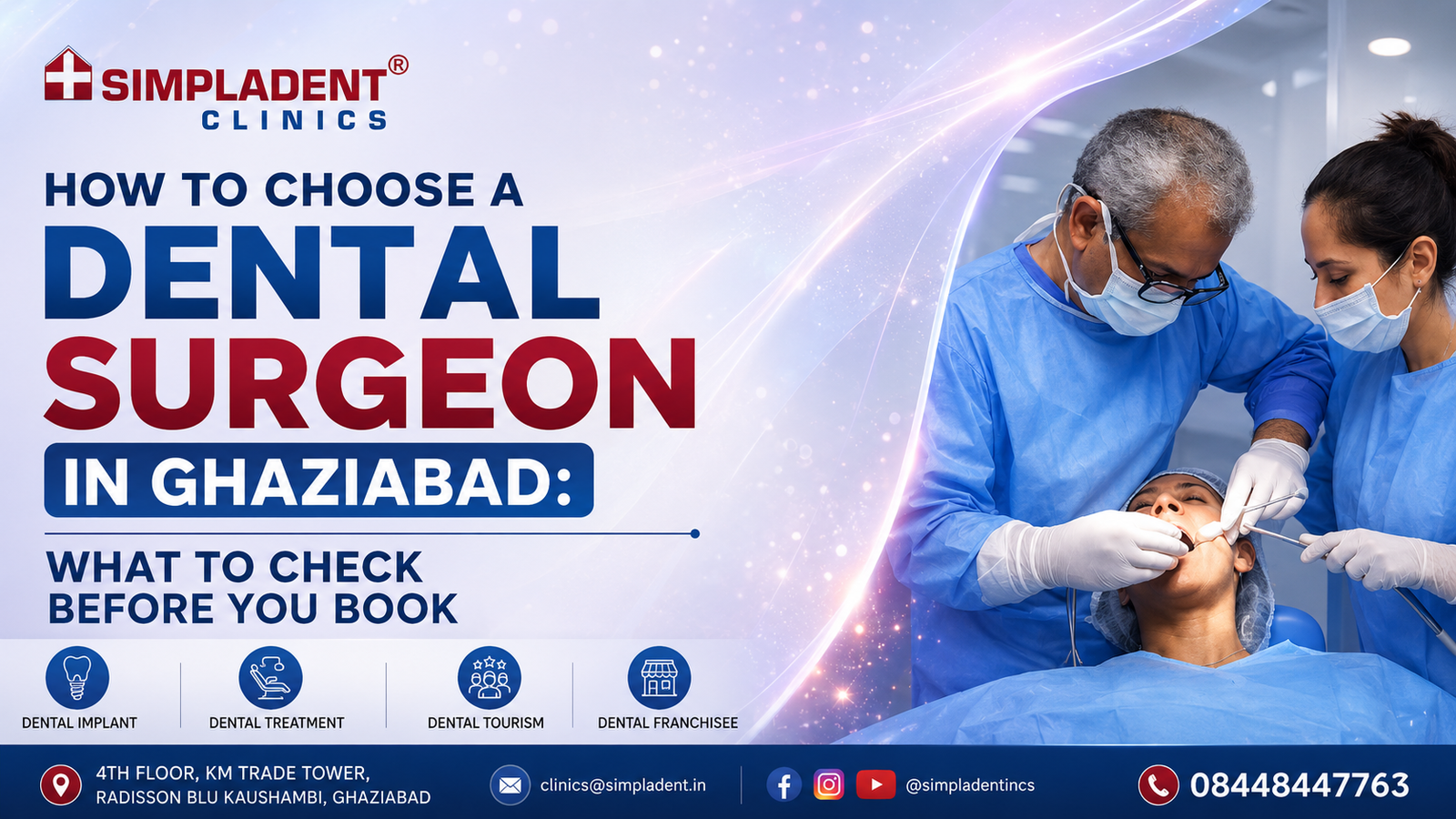
If you are searching for the Best Dental Surgeon in Ghaziabad, what you are really trying to establish is narrower than the phrase suggests: is this surgeon qualified for my case, is the clinic accountable, and will I be told the truth about what is realistic? Those three questions are answerable. Marketing superlatives are not. Below is the checklist we would want a family member to use — including the points where another clinic may be the better answer.
Check the Qualification, not the Job Title
In India, “dentist” and “oral and maxillofacial surgeon” are not interchangeable. A BDS is a dental graduate. An MDS in Oral & Maxillofacial Surgery is a specialist trained in surgical management of the jaws and facial skeleton. For a straightforward single implant, a well-trained general dental surgeon is often entirely appropriate. For severely resorbed bone, previously failed implants, or full-arch rehabilitation, surgical specialisation genuinely matters.
Ask for the registration number and verify it with the state dental council. Any clinic that hesitates has told you something useful.
At Simpladent Clinics, Kaushambi, treatment is led by Dr. Vivek Gaur — Oral & Maxillofacial Surgeon (RUHS), BDS (Manipal), Master Clinician in Implants from UCLA (2012), and Masters in Immediate Loading from the International Implant Foundation, Munich (2012), where he has taught since 2013.
Ask What Happens if There is Not Enough Bone
This is the question that separates a real consultation from a sales pitch. Long-term tooth loss causes the alveolar ridge to resorb, and conventional implants need adequate ridge volume. The standard answer is bone grafting or a sinus lift, adding months and cost.
The alternative approach used at Simpladent is corticobasal implantation — single-piece implants anchored in the denser cortical bone, which resorbs more slowly than alveolar bone, allowing immediate functional loading. In suitable cases this means fixed teeth are fitted in roughly 72 hours to five days, often without grafting.
Here is the part most pages leave out. The long-term outcome literature for basal and corticobasal implants is still largely case-series level and is weaker than the decade-plus survival data available for conventional implants. That does not make the method unsound — it means it should be presented as an appropriate option for specific clinical situations, particularly severe bone loss or patients who want to avoid grafting, rather than as automatically superior. If your bone volume is good and you are not in a hurry, conventional implants remain a well-evidenced route, and a surgeon who says so is being straight with you.
Look for Institutional Accountability
A good dental clinic in Ghaziabad should be able to show more than a photo gallery. Practical markers:
Accreditation. Simpladent Clinics is NABH-accredited, which means documented protocols for sterilisation, records and patient safety are externally audited rather than self-declared.
Implant Provenance. Ask which system is used and whether it is CDSCO-licensed. Implants are regulated medical devices; the brand should be named in writing on your treatment record.
On-site Imaging. In-house OPG and CBCT matter because bone assessment happens in the same visit, and the surgeon plans from your actual anatomy rather than a referral report.
Written Treatment Plan. Number of implants, arch, prosthesis material, review schedule.
Judge the Consultation, Not the Promise
Be cautious of guaranteed outcomes, “lifetime” or “permanent” claims, “painless” language, or a single quoted success percentage. Implant dentistry is biological — outcomes vary with bone quality, oral hygiene, smoking, diabetes control and bite forces.
Patients with diabetes or a smoking history are frequently treatable, but suitability is determined after individual assessment, not promised in advance. Treatment is performed under local anaesthesia and most patients report manageable discomfort, but no honest clinic will promise you feel nothing.
Ask instead: what is the follow-up schedule, what happens if an implant fails, and who do I call at 9pm on a Sunday.
Practical access in Ghaziabad and Delhi NCR
Simpladent Clinics is at 417, 4th Floor, KM Trade Tower, H-3, Sector-14, near Radisson Blu Kaushambi, Ghaziabad, Uttar Pradesh 201010 — beside Kaushambi Metro on the Blue Line, which makes it reachable from Indirapuram, Vaishali, Anand Vihar and East Delhi without crossing city traffic. Toll free: +91-844-844-77-63. Email: clinics@simpladent.in.
Frequently asked questions
Are basal implants safe?
They are used clinically worldwide and are CDSCO-regulated in India. The published long-term evidence base is less mature than for conventional implants, so candidacy should be decided case by case after imaging and assessment.
Can I Really Get Fixed Teeth in 72 Hours?
In suitable cases, yes — a fixed prosthesis is typically fitted within about 72 hours to five days of placement. Whether your case qualifies depends on bone assessment.
Do You Guarantee Implants for Life?
No clinic can. What is offered is a documented protocol, a defined review schedule, and honest discussion of the factors affecting longevity.
What Does Treatment Cost?
Cost depends on the number of implants, single arch versus full mouth, prosthesis material and case complexity. Current figures are given at consultation.

 Facebook
 Youtube
 Twitter
 Instagram
 Linkedin

Leave A Comment