
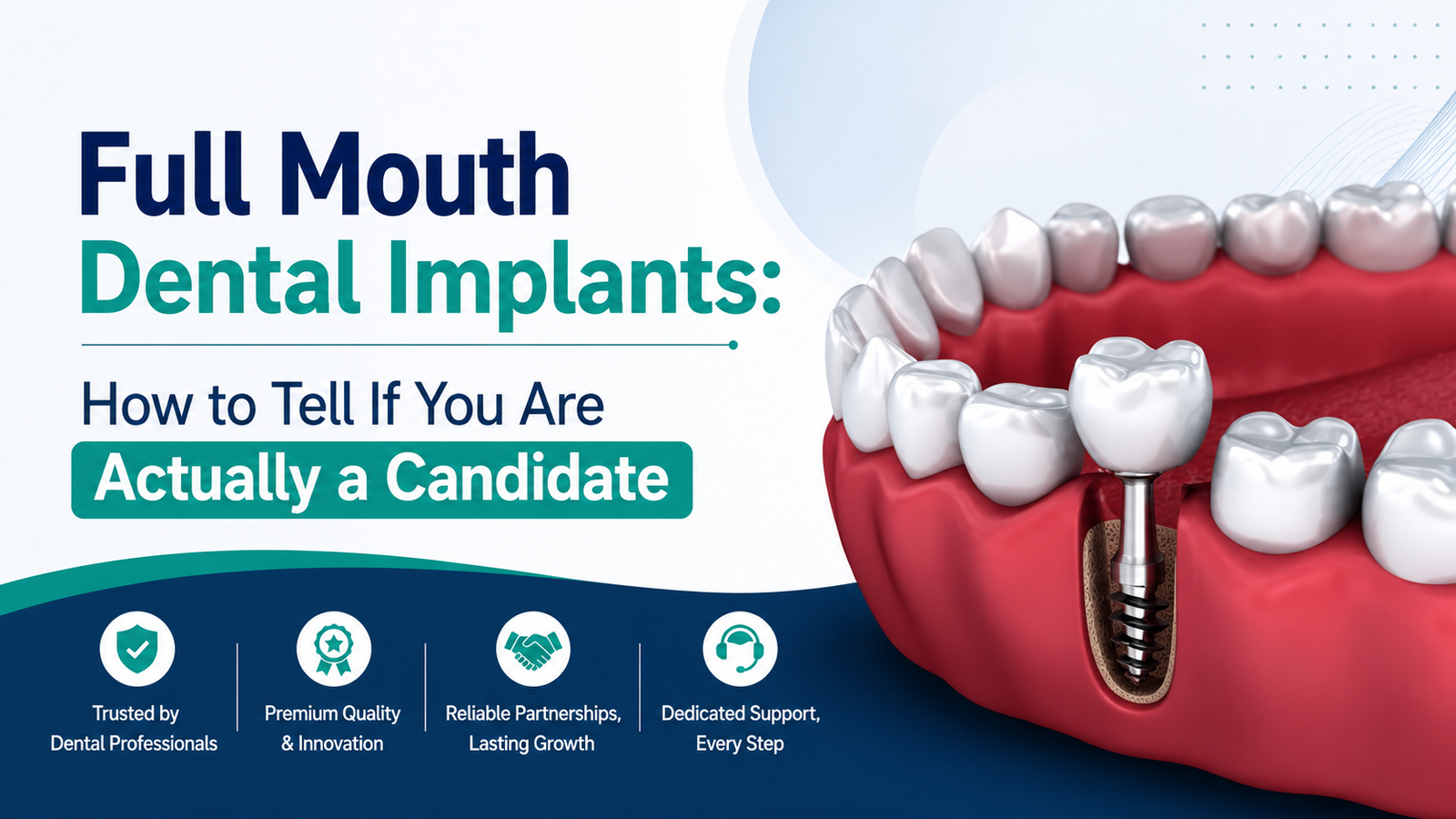
Full mouth dental implants replace an entire arch — or both arches — of missing or failing teeth with a fixed bridge supported by implants placed in the jaw. At Simpladent Clinics in Kaushambi, Ghaziabad, most full-arch cases are treated using single-piece cortical (basal) implants under an immediate-loading protocol, which means fixed teeth are typically fitted within about 72 hours rather than after several months of healing. Whether that route suits you depends on your bone, your general health, and what your scan shows — which is what this article is about.
What “Full Mouth” Really Means
The phrase misleads people. It does not mean one implant per missing tooth. A full arch is usually rehabilitated on a smaller number of strategically positioned implants that carry a single fixed bridge. Fewer surgical sites, one prosthesis, one bite to balance.
The difference in our protocol lies in where the implant anchors. Conventional implants rely on the spongy alveolar bone that surrounds tooth roots — the bone that shrinks after teeth are lost, which is why grafting and sinus lifts are so often proposed. Cortical implants are designed to engage the dense, load-bearing cortical bone deeper in the jaw, which resorbs far more slowly. That anchorage is what makes immediate loading possible in suitable cases, and it is why many patients told they had “not enough bone” can still be treated without grafting.
Who Tends to be a Good Candidate
Patients who come to us for full mouth dental implants usually fall into one of a few groups:
Long-term denture wearers whose lower denture no longer stays put, and who have lost significant ridge height.
Patients with advanced periodontal disease, where several teeth are mobile and staged extraction-then-heal-then-implant would mean a year or more without fixed teeth.
People who have been quoted bone grafting or a sinus lift elsewhere and want to know whether there is a graftless route.
Patients who need a compressed treatment window — including international patients travelling for care.
Medically controlled diabetes and a smoking history are not automatic disqualifications, but both affect healing and both are assessed individually before we plan anything.
Who it Does Not Suit
This is the part most implant pages leave out, so here it is plainly. Cortical immediate loading is not the right answer for everyone. Uncontrolled diabetes, active heavy smoking, untreated bruxism, certain bisphosphonate or radiotherapy histories, and patients unwilling to commit to follow-up reviews all change the risk picture. In some single-tooth and partially dentate cases, a conventional two-piece implant is simply the better-evidenced choice — that literature has a longer and deeper outcome record, and we will say so if that is what your case calls for.
It is also worth being straight about the evidence base itself. Published outcome data on cortical/basal implants is thinner and of lower evidential grade than the long-term data behind conventional implants. What that means in practice: we can describe what we do, what we see, and what the risks are — but nobody should be offering you a guaranteed result, and you should be wary of anyone who does.
What the Process Actually Looks Like
Assessment. A CBCT scan, a medical history review, and a clinical examination. The scan decides the plan; nothing is quoted or promised before it.
Placement. Extractions where needed and implant placement in a single surgical session, under local anaesthesia. Most patients report manageable discomfort; pain relief is planned in advance.
Fixed teeth. In suitable cases, the fixed bridge is fitted within about 72 hours. Timelines vary with the case.
Follow-up. Reviews, bite adjustment, and hygiene instruction. Long-term outcomes depend heavily on maintenance and on you attending recalls.
What Drives the Cost
We do not publish a single figure, because a single figure would be misleading. Full Mouth Dental Implants are priced by the number of implants required, whether one arch or both are being treated, the prosthesis material chosen, imaging, and the complexity of the case — including whether existing teeth need removal. Any honest number comes after the scan, at consultation.
Before You Commit
Ask any clinic three questions: what does my scan actually show, what happens if an implant fails, and what does long-term maintenance involve. A clinic that answers those directly is telling you something useful. Simpladent Clinics is NABH-accredited and works with CDSCO-licensed implant systems, and we would rather you arrived with hard questions than with expectations we cannot meet.
To arrange an assessment: Simpladent Clinics, 4th Floor, KM Trade Tower, near Radisson Blu, Kaushambi, Ghaziabad. Toll free +91-844-844-77-63 or clinics@simpladent.in.
Keep yourself updated by following our Social Page for the latest news and information.

 Facebook
 Youtube
 Twitter
 Instagram
 Linkedin

Leave A Comment